
Operational disruptions arrive without warning. A key supplier collapses, a critical system fails, a facility becomes unusable overnight, or a sudden regulatory change forces an immediate process overhaul. Leaders who have never rehearsed for this kind of pressure often make the same mistakes — overcommunicating chaos, undercommunicating direction, or freezing entirely while waiting for clarity that may never come on schedule. What separates teams that recover quickly from those that lose weeks of momentum is rarely resources or luck. It is how leadership behaves in the first 72 hours, and the decisions made in the weeks that follow.
Stabilize Before You Strategize
The instinct to pivot immediately into a new plan is understandable, but acting before the full scope of disruption is mapped usually compounds the problem. Decisions made in the first hours of a crisis are often based on incomplete information — and reversing a poorly chosen course costs time and credibility.
The more productive first move is containment. Identify which operations are genuinely impaired versus which merely feel uncertain. Not every department is equally affected by a given disruption, and treating the whole organization as equally destabilized creates unnecessary fear and paralysis.
A practical triage approach:
- Within the first 4 hours of a disruption, hold a 30-minute assessment meeting with department heads to classify each function as fully operational, partially impaired, or halted.
- Assign a single point of contact for each impaired function — not a committee — to own information gathering and initial response for that area.
- Set a firm 24-hour window before any major structural decisions are communicated, unless life safety or legal compliance requires faster action.
The last point is where many leaders stumble. Pressure from board members, senior stakeholders, or anxious teams pushes leaders to announce solutions before solutions exist. Announcing a plan that changes twice in 48 hours damages trust more than saying “we are assessing this and will have a direction for you by tomorrow at noon.” Teams can tolerate uncertainty; what they struggle with is inconsistency.
Communication Under Pressure — What to Say and When
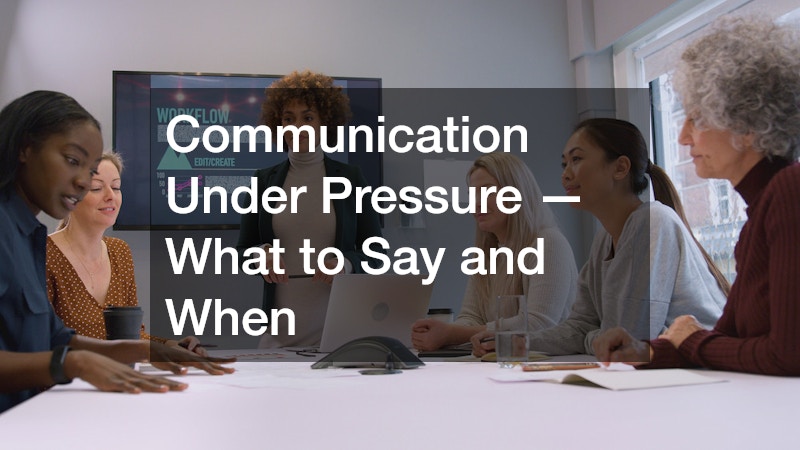
Information vacuums fill with rumor. When leaders go quiet during disruption — even for a few hours — teams generate their own narratives, and those narratives are almost always worse than the actual situation. The communication strategy during operational upheaval needs to be deliberate, not reactive.
Two broad approaches exist. The first is reactive communication: leaders respond to questions as they arise, issue updates when major developments occur, and otherwise stay focused on solving the problem. The second is scheduled communication: leaders set a fixed cadence — for example, a brief all-hands message each morning and a department-level check-in each afternoon — regardless of whether there is major news to share.
Reactive communication feels efficient but consistently underperforms in practice. When the update schedule is unpredictable, every period of silence becomes its own event. Scheduled communication, even when brief and low on new information, signals control and intentionality. A 90-second recorded message that says “here is where we stand, here is what the team is focused on today, we will update you again at 4 p.m.” accomplishes more than a detailed memo issued at irregular intervals.
What the message contains matters less than most leaders assume. Research on organizational resilience consistently shows that employees during a crisis weight tone and consistency more heavily than the content of individual updates. Calmness and predictability in leadership communication are the signal that the organization is functioning, even when the situation is not.
Physical and Operational Continuity — The Decisions That Define Recovery
Not all disruptions are digital or procedural. Physical displacement — a flooded office, a building condemned after infrastructure damage, a rapid facility transition — forces organizations to make hard choices under time pressure. These situations require leaders to separate what is genuinely urgent from what merely feels that way.
The critical decision in physical disruption is usually between three options: temporary remote operations, interim leased space, or a permanent relocation triggered earlier than planned. Each carries distinct trade-offs.
Temporary remote operations preserve continuity fastest but degrade coordination over time, particularly for teams that rely on physical materials, equipment, or client-facing presence. Most organizations can sustain effective remote operations for two to six weeks before collaboration costs begin to outweigh logistical savings.
Interim leased space is expensive — short-term commercial leases often carry a 20-30% premium over standard market rates — but it preserves team cohesion and operational structure. For organizations with more than 40 employees, the productivity cost of fragmented remote work frequently exceeds that rental premium within a month.
Permanent relocation, when it becomes necessary, involves a layer of operational complexity that teams rarely anticipate fully. Coordinating infrastructure setup, vendor access, and physical equipment transfer while maintaining daily operations requires external support. office moving companies experienced in commercial transitions understand the sequencing involved — what to move first, how to stage a partial occupancy, and how to minimize the window during which neither location is fully functional.
Regardless of which path is chosen, document the decision criteria. Six months after a disruption, organizations that recorded why they made specific calls under pressure are significantly better positioned to improve their response frameworks than those that simply reacted and moved on.
Protecting Team Performance During Extended Uncertainty
A disruption that resolves in a week is a stress event. One that drags across several weeks or months becomes a performance management challenge. Sustained uncertainty erodes motivation, accelerates burnout, and triggers voluntary turnover — often among the employees with the most options, which means the strongest performers.
Leaders who navigate extended upheaval well tend to make one adjustment that feels counterintuitive: they narrow the team’s focus rather than expanding it. When everything is in flux, the temptation is to tackle every outstanding problem simultaneously. The teams that hold their output levels steady are usually those given a short list of priorities — three to five items maximum — that remain stable even when the broader environment does not.
Specific practices that measurably support team performance during sustained disruption:
- Reset individual performance expectations in writing within the first two weeks of an extended disruption, adjusting output targets by 15-25% where operational constraints are documented.
- Schedule one-on-one check-ins at least every five business days — not to review task lists, but explicitly to surface blockers and wellbeing concerns before they compound.
- Identify two or three team members showing signs of early burnout (missed deadlines, shorter responses, withdrawal from collaborative tasks) and assign them reduced-scope work with a defined recovery window.
The organizations most likely to emerge from operational disruption with their culture intact are those that treat personnel stability as an operational priority — not an HR concern to be addressed once everything else settles.
Making the Decision to Move Forward
At some point, extended disruption mode becomes its own operational risk. The moment to transition from crisis management back to standard operations is rarely obvious, but waiting too long carries real costs — teams habituated to lower expectations, deferred decisions that accumulate into a backlog, and a cultural hangover that can persist for months. A structured exit from crisis posture means formally resetting performance standards, closing the temporary communication cadences, and conducting a documented after-action review within 30 days of stabilization. That review is not about assigning blame — it is about identifying the two or three changes that would meaningfully reduce the organization’s exposure the next time an operational disruption arrives unannounced.